Scoping Cybernomos: TOKII & TOKOGAE
audio here
Two Trees
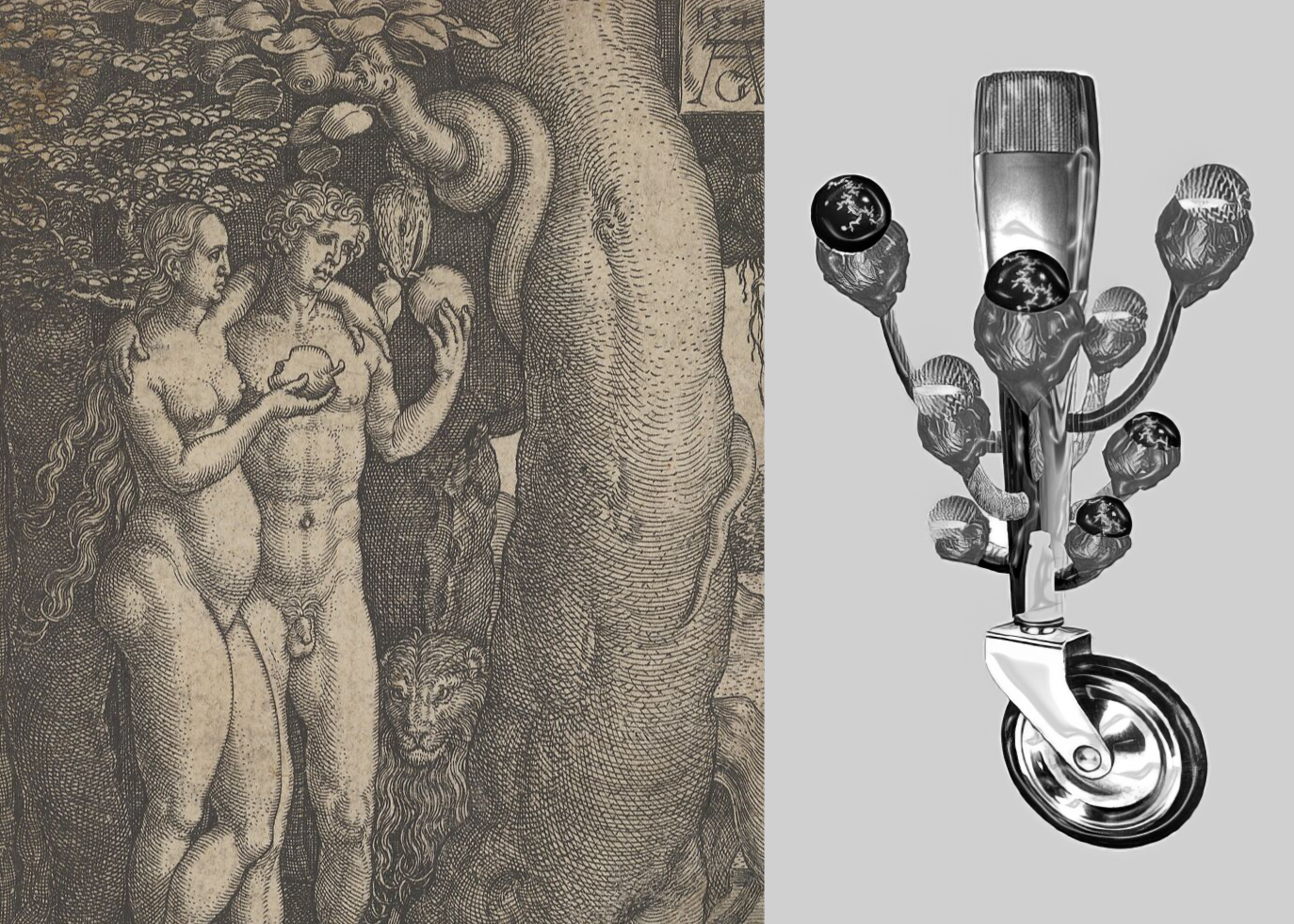
The first of the two trees in question is the enigmatic, entirely novel, Tree of Knowledge Irony Indicator—TOKII. A purpose-built rhetorical figure originally conceived (1996) as humanity approached the dawn of a new, increasingly secular, millennium. The creation of a sign designed to assist with thinking about the notion of governance in relation to knowledge. Now mobilized here to represent our ambiguous-uncertain yet essentially promising relationship to AI. This, and the other more culturally familiar tree-figure, the Tree of Knowledge of Good and Evil—TOKOGAE. The former contemporary tree-figure was inspired by the ancient latter. Which, as those of us from Judaeo Christian, or such culturally influenced religious backgrounds will recall, provides the central symbolic metaphorical figure of the allegorical structure of the Eden Narrative, within the book of Genesis, of Bible’s various.
The Biblical Insight
Our putative Cybernomos Institute could arguably take the theological relationship of the TOKOGAE/TOKII connection and develop it as an interdisciplinary project. That in consultation with religious authorities, could produce educational materials that develop the interaction between these two symbolic metaphorical figures for the machine intelligence age. It’s with a certain quality of understatement, that we can confidently say, that the institutions of monotheism have a great deal of experience when it comes to managing the mortal, existential concerns, of human existence. It makes strategic sense, and is arguably spiritually wise, if embracing the indeterminacy of outcomes that machine intelligence prefigures, to engage with religious networks in order to increase the quality of the institutes messaging. Theologians have several millennia of experience in cultivating and interrogating an abstract intelligent epiphenomenon of consciousness, specifically involved in the governance of the human condition. The technological republics we are intent on creating might need as many talented theologians as we currently need gifted responsible engineers.
Implicit from the reading pursued here of TOKOGAE’s metaphorical discursive function in the Eden Narrative of Genesis, from the biblical insight, is that man requires governance, that effective flexible control itself ideally requires frameworks of external yet symbiotic governance. Monotheism from this agnostic perspective looks like a necessary invention, or it could be spiritual revelation, or both. Either way, mind-on-mind, the requirement of an omniscient deity to undertake this task constitutes a form of symbiotic artificial intelligence-SAI. Not ‘artificial’ as in fake, or constructed, as the misnomer artificial implies, but the formulation of an epiphenomenon of consciousness. That is a deity, or in secular terms an equally admired intellectual presence, that is authoritatively separate, yet uniquely molded-connected to the evolving needs of the human condition.
Arguably what governance in the age of AI requires is a similar approach. That in the absence of a solution to the problem of alignment, instead of just attempting to pursue the impulse to moralize AI, with, as already noted, the seemingly impossibly contentious prospect of accommodating competing moral visions, we should also be looking to see how AI could assist, in governance terms, with the evolving project of moralizing ourselves. This paradoxically ironic realization, of the need to solve the governance problems created by AI, through the creation of a symbiotic relationship with AI, of deploying AI to further our own moral development, our own governance potential, is itself, one of the primary messages that can be embodied-indicated by the symbolic metaphorical figure of TOKII.
What the Hebrew Bibles editors were at pains to explicate within Genesis—what was set out before the world as the political implications of Jewish moral seriousness—is the need for governance. Adam & Eve could no longer be trusted with a God-like access to the entirety of the known, especially when this is coupled with the prospect of eternal life! They plainly demonstrated a lack of self-control when expressly asked to, not-repeat-not, do the one thing that was asked of them: that is to partake of the forbidden fruit of the TOKOGAE. For the allegory of the Eden Narrative to ring true, it needed/needs to register on a personal subjective level an inherent truth regarding the human condition. That this patent lack of control, when considered-weighed in the light of the conspicuously welcome, intrinsically human repertoire of our curiosity and appetites, is not something easily managed; notably something for which we might need help. Our naive curious couple, speeding quickly through their childlike innocence into the realm of conscious maturity, were, rhetorically speaking, set up to fail, because we humans habitually do. The economy with which this allegorical narrative demonstrates this, paves the way for, signals the need for, the subsequent contractual covenants of an Almighty God, and the monotheistic legacy of our human history. The recognition-endurance of the truth of this realization, arguably the most influential in the history of human governance, also reveals the psychological sophistication required to mobilize this revelation.
Thinking Communicating Visually
The relationship between the visual metaphorical figures of TOKII and TOKOGAE are put forward here as a discursive entry into, and a means of productively thinking about, issues concerning governance and AI. That with the advent of another species of intelligence to rival our own—which currently effectively functions as an outgrowth of it, but is destined not to be limited by this—does not necessarily mean that we cannot effectively, safely, deploy it. Either to assist with existing problems of governance, or indeed the ensuing problems for governance that AI is likely to generate in the future. So we need a means to remind ourselves, and particularly a visual means, because we live in a visual culture, of the delicate path we need to tread in developing this technology. An important signifier of both the promise and threat of this technology that once adopted by consciousness, can itself act upon consciousness. The more time, and the specificity, with which we seek to entrench the fundamental understanding regarding the radical indeterminacy of machine intelligence the better.
If, like me, you benefit from thinking visually, with the prospect of the visual assisting to ‘hold that thought’, then you’ll hopefully appreciate, when we explore the relationship between these visual figures in more detail, how they map out, albeit in markedly different terrain, a conceptual concern with the notion of a symbiotic artificial intelligence—SAI. Arguably, with the introduction of a new species of intelligence we should be thinking about how we want to coexist with it; regardless of whether it becomes, or is in some sense designated, a conscious entity, or not. Here then the elegant example of the internal externality of the God-partition has informed, and can continue to inform, the prospect of good governance in human affairs.
Irony Squared²
What also links the two trees, apart from the central thematic concern with governance, what is carried over from one symbolic metaphorical figure TOKOGAE, to the figure of TOKII, is a disposition toward, a thematic concern with, the ironic. Irony as a literary trope plays a significant part in the allegorical reading of events from the Garden of Eden. As what happens to our progenitor human beings is both paradoxical and ironic. The deeper truth revealed by this paradoxical irony is that Adam & Eve’s newfound freedom, yet expulsion from paradise—following the economic allegorical rhetorical intention of the Hebrew Bible’s editorial compilers—is not primarily that the TOKOGAE signifies the burgeoning moral autonomy of our prototype couple, although it does do that, but rather a demonstrable need for an external factor in the stewardship of the human condition.
Foundational to TOKII’s insight, in a repertoire of indications, is the notion that the acquisition of knowledge is fundamentally morally neutral. That knowledge itself presents as a control issue. The discursive rhetorical intention behind the invention of TOKII is that in exploring the wonders of machine intelligence, as we seek to automate and deploy artificial neural networks, we might lose control of our objectives. And, flying too close to the sun, inadvertently invite a cacophony of existential risk upon ourselves. Yes, it’s extremely ironic that in exploring our ingenious technological wonders we might manage to self-destruct; or perhaps worse still proceed to make the biological substrate of humanity increasingly irrelevant.
A significant proportion of critical reflection upon our AI future, if not explicitly doom-laden, is concerned with our collective capacity to negotiate what lies ahead. This perspective is weighed in the negative by incisively legitimate critical concerns. It’s also a situation that sophisticated ironists like to habitually inhabit. Largely to point out, and thereby distance themselves, from say the logical lunacy of something like—MAD, the nuclear arms mantra of mutually assured destruction. But having backed into our abject selves as far as we can go with that threat, we’re now arguably at the point-stage of no return with the enigmatic arrival of AI. A situation where we now need to be ironic about the ironists, irony squared if you will. Where there’s now a pressing need to seriously consider-unpack what all this manmade irony, in all its layering, fundamentally indicates; not-repeat-not smugly revel in the drama of it all. It’s one thing to acknowledge that something’s ironic, it’s another thing altogether to assume that that’s sufficient an observation to remove yourself from addressing the imposition of such existential dilemmas. That’s just plain laziness; besides, that’s the point when it actually starts to get interesting.
TOKOGAE / TOKII & Cybernetics
“I think that cybernetics is the biggest bite out of the fruit of the Tree of Knowledge that mankind has taken in the last 2,000 years.”1
A claim made by Gregory Bateson, an influential Anthropologist, at the height of his countercultural influence in the early 1970’s. What I take Bateson to be alluding to is a more adaptive, holistic, conception of the world, with negative feedback loops conceived as a positive basis for adaptation. This would represent a seismic shift from understanding the world through linear chains of cause and effect to recognizing interdependent systems, in which the consequences of actions feedback to shape subsequent behavior. There’s also something inherently evolutionary about Bateson’s conception of cybernetics, in which adaptation and survival depend on the continuing relationship between organisms and their environments. Within this scoping agenda, Bateson offers a point of return to a promising intellectual direction within cybernetic history. One familiar trajectory emphasizes the engineering of intelligent machines, with cybernetics and information theory contributing to developments in machine learning and artificial intelligence. Another, exemplified by Bateson, explores the philosophical, social and ecological implications of learning, communication and control. These trajectories overlap, but this scoping agenda proposes bringing the latter more firmly into the foreground of AI governance. What makes his agenda worth retrieving is the question it opens up: How does the pursuit of machine intelligence reshape the dialogical relationship between humans and their environments, and with what consequences for adaptation and survival?
Arguably Bateson and Weiner were two amongst the most prominent figures in the history of Cybernetics, who profoundly understood the duality of machine learning more than most, the idea that knowledge/information is morally neutral. That how we seek to deploy our understanding of the natural world, how we seek to exploit our discoveries, may ultimately lead to them exploiting us. That in terms of expanding a parallel cognitive facility, it is a case of being very careful what you wish for. Kubernetes, from the Greek to steer, signifies the principal functional normative role of governance. As with the bible, what’s significant about Bateson reaching back to TOKOGAE, to the tree of knowledge figure, is the centrality of the governance issue. Bateson’s shrewd apprehension that cybernetics contains the potential to do both good and harm, what he considered as the indigestible part of the ‘big bite’ from the tree of knowledge. That if insufficiently theorized, if deployed in a reductive way, the twin pillars of communication and control—coupled to the potential autonomy of computational systems—will become self-serving rather than functionally adaptive for the purposes of human flourishing; or indeed, like AI itself, present the possibility of a dangerous segue into authoritarianism.
[1] Bateson, Gregory. “From Versailles to Cybernetics,” a lecture delivered on 21 April 1966, printed within Steps to an Ecology of Mind: Collected Essays in Anthropology, Psychiatry, Evolution, and Epistemology. San Francisco: Chandler Publishing Company, 1972.p. 481.