Scoping Cybernomos: ASI
audio here
A Scalable Concept
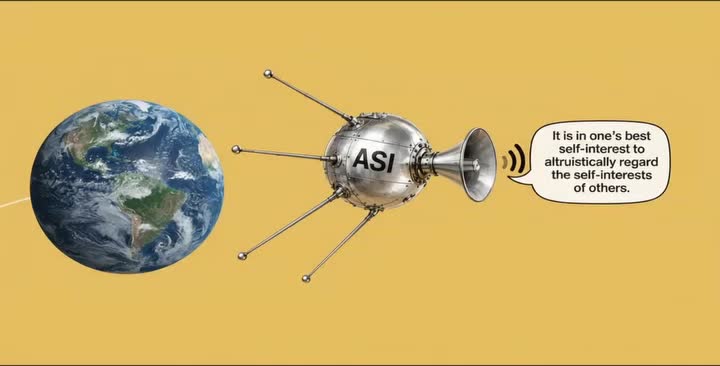
One important aspect of ASI is that it is, as a governance principle, a scalable concept applicable to a range of governance scenarios. By this, I don’t just mean in the Kantian sense, that it’s a virtuous principle, one that you’d wish to see universally applied. I also mean that ASI populates the realm of the politically personal as much as it could be beneficial at the other end of the scale with regards to geopolitical influence. Or indeed a generative thought process that helps foster our empathic capacity to consider the personhood of others. That is a broad sociological conception of governance to include the intrapersonal/interpersonal/intercultural relations; and the bridging skills required to navigate the transitional gaps between them. A range of governance application, from the ordinary encounter to the institutional arrangement. Therefore a governance principle imbued with far reaching moral pragmatism; and one with political philosophical implications for the concept of, and security and development of, the sovereign biological individual. Considered formally—The Principle of Altruistic Self-Interest—might at first seem like an oxymoron, or rather, something distinctly paradoxical. Altruism and self-interest have so often been used in an antithetical way to represent opposing positions regarding these normative attributes of human nature. Yet if we consider that individuals live in a series of nested groups, their lives thoroughly implicated in the lives of others, then the apparent contradiction between these binary terms begins to look rather different.
ASI As Intrapersonal Governance
Intrapersonal governance concerns the deliberation that takes place within the individual: how we examine our motives, negotiate competing interests, and arrive at decisions about the kind of life we intend to lead. ASI has a place within that deliberation because it questions the apparent opposition between attending to oneself and attending to others. Our interests take shape within relationships and conditions of mutual interdependence. To recognize those relationships is to enlarge our understanding of what self-interest involves; that a possessive concern for others can be constitutive of a life we have reason to value. That a generative altruistic thought process, one that helps foster our empathic capacity to consider the personhood of others, will ultimately be of self-interest, be of value to ourselves. If you are not directing your thought processes toward the constructive goal of altruistically considering the self-interests, the personhood of another human being, rather than needlessly competing with them, or being dismissive about them just because you can, then you are not addressing their best self-interests, or your own.
The advent of social media has unleashed an avalanche of vitriolic bile in our social relations that has been mobilized to sell advertising space and make a few individuals rich. Instead of being manipulated by screen capture, that only impoverishes your sense of self, it would be much better for you, your social life, and the people around you, if you actually altruistically empathically thought about their personhood respectfully, and tried to accommodate differences where you can. If you are constantly thinking negative thoughts about other people, rather than trying to help them, if possible —and you are effectively being trained to behave like that—then this will surely diminish your own existence, and your capacity to create a meaningful social life.
Intrapersonal Governance is all about decisions. So, how does ASI play out when morally addressing our responsibility to future generations? One of the virtues of considering the moral philosophy of Longtermism—and I would argue its principal virtue if considered within the domain of intrapersonal governance—is what such consideration brings to lives being lived now. This might seem counterintuitive considering that this moral philosophy is explicitly concerned with why we should consider the quality of the lives of future people. Where the individual is invited to consider their personal contribution to sustaining the conditions in which those future lives might flourish. ASI asserts that the value of such ethical consideration extends beyond the consequences we hope to bring about. That is in accepting that responsibility it can by itself lend moral credence to the dignity and purpose of a present life. ASI states that our own self-interests are best served by altruistically considering the self-interests of others. When applied to our relationship with future generations, it offers a way of understanding-accepting responsibility for the future as part of the morally good life lived now. ASI also provides grounds for resisting those extreme forms of moral calculation in which present lives become expendable sacrificial preparations for a supposedly greater future. The point of lives lived now cannot be merely to prepare for the lives of future humans. That would be an irksome responsibility, particularly if the individual’s own purposes were persistently diminished when adjusted to the visionary needs of an indefinitely expanding future. Where a person would be persuaded to understand their life primarily as an instrument toward outcomes they could neither experience nor could reliably determine.
ASI offers a different basis for accepting a temporal moral responsibility toward future lives. An important philosophical and pragmatic consideration. Where the individual initiates thought processes through which their own participation in sustaining Life, becomes in part, intelligible as moral responsibility toward future lives. A process that lends shape and credence to their life now. To reflect upon what it means to contribute, what lies within their capacity, and how their choices relate to conditions that support future others. Such intrapersonal reflection can give direction to present action even where its distant consequences remain uncertain. That in this process of asserting a moral commitment to the importance of future lives, such a commitment may find expression in many forms. Here the altruistic and self-interested dimensions of such thought and activity collapse into lives well lived. If the individual attends to the interests of others, and through that cultivated interdependence across time develops a more purposeful relationship with their own life, then this is all to the good.
ASI is a pragmatic logically moral principle of governance, and EA, effective altruism, is a pragmatic movement seeking to make calculated interventions, financial or otherwise, toward the survival and flourishing of the human condition. What they both share is a concern regarding a lack of effective governance; especially as the human condition makes its transition to its posthuman status, and posthuman responsibilities. As an institutional entity the proposed Cybernomos Institutes are conceived as a form of temporary transitional governance. Specifically concerned with negotiating this dangerous interregnum, of which future considerations are an illuminating important part, but still but a part of the calculation. If the objective is either to preserve-improve Life, or for some to ultimately evolve to transcend it, the future is now fully occupying the present. The virtue of EA, how it populates our intrapersonal decision making is that it understands what’s at stake—now—for the future. The necessary importance we should be allocating the meta-governance, historical advent, of AI. That requires us to seriously pursue our logically moral obligations toward that future.
ASI As Interpersonal Governance
Experientially, from a personally political perspective, what I’ve found intriguing is how the notion of ASI bifurcates into your thinking if you let it. Let me illustrate this with an example. One day whilst out with my dog Rulo traversing along a narrow wooden jetty, a popular walkway that snakes across the brackish reeded waters of a local bay, that provides a scenic route for exercisers of all types, something interesting happened. Heading back home I noticed a cyclist coming in my direction. Calculating we would converge in the middle of a difficult ‘S’ bend on the jetty, the instant decision was to wait for the cyclist to complete this first to avoid any potential calamity. Preparing myself just to nod to him on his way past, he pulled up, thanked me for my courtesy, then asked me why I’d stopped. I mumbled something about having a research degree, and thought that it might be a good idea to offer him safe passage. That is by insisting that I was just dusting down the old noggin, getting my brain into gear, calculating possible outcomes, some of which might not have been good. My beguiling Rulo being a jumper, a many-handled rescue of uncertain provenance, yet certain anxieties, with a tendency to effortlessly compromise me in public. So was I just being understandably sensible?
Was I just being pragmatic rather than nice? On reflection it would have been more interesting if instead of the somewhat queasy-quasi bragging about how smart this decision was, I should have gone all out and initiated an in-depth discussion regarding the principle of altruistic self-interest. Life’s wasted opportunities! Never mind, in the spirit of that experience Iet’s carry on with what this encounter affords. To me at least, if a solution to an equation is being sort between the pragmatic and nice, we can reasonably say that the pragmatic was nice; and leave it at that. It was of no great inconvenience to me to wait for a few seconds for a cyclist to navigate this difficult path first. We both had a right to meet each other at the difficult impasse, but I chose to make his life (and mine) easier. My understanding of this is that I didn’t want to make the situation unnecessarily more difficult than it needed to be, he was on a bike after all. Rather than me just being understandably concerned with the random behavioral eccentricities of my wayward hound. That is, I was empathically more concerned, however minor, with his self-interests rather than mine. Given that these decisions are often not premeditated, made in a split second, was it just a reciprocal curtesy that this spontaneous gesture had prompted him to stop to thank me? If so why not leave it at that. Why had he felt compelled to ask why I had presented him with safe passage? Had he registered something interesting about my empathic concern? I might have usefully run into a professor of philosophy; I’ll probably never know.
Still the question remains to be answered: That is, I can see how it benefited the cyclist trying to navigate a difficult path, but in what sense is this of altruistic self-interest to me? A response can be approached from different angles: I was pleased to see how my decision had contributed to him safely navigating a tricky situation; I was also pleased that he responded to this kindness by enquiring why I’d done it; I was further pleased that I’d been sensible enough to realize that the contribution of myself coupled to rowdy hound could have made matters worse. But this minor act of civility is comparatively miniscule when we factor in the potential abstract capacity of its future influence; then we might truly begin to consider its worth. What if hypothetically our situations are reversed one day: That is I’m now—or importantly anyone else for that matter—hurtling toward a dangerous ‘S’ bend on a bike, and have to navigate my Rulo, or the like, through this difficult impasse, he remembers my kindness, he stops with hound, we both nod at each other and go on our merry way. This surely is a preferable world, a preferable reality, where, if we can act upon the principle of altruistic self-interest: where it’s in our best self-interest to attend to the self-interest of others, then we should do so.
Returning to Longtermism. William MacAskill in developing the temporal notion that if we start to calculate the effect that our actions, or inactions, have on the future lives of people this will sharpen our moral sensibilities considerably. He offers this tidying illustration in the service of future goods as an example:
“The idea that future people count is common sense. Future people after all, are people. They will exist. They will have hopes and joys and pains and regrets, just like the rest of us. They just don’t exist yet…..
To see how intuitive this is, suppose that, while hiking, I drop a glass bottle on the trail and it shatters. And suppose that if I don’t clean it up, later a child will cut herself badly on the shards. In deciding whether to clean it up, does it matter when the child will cut herself? Should I care whether it’s a week, or a decade, or a century from now? No. Harm is harm, whenever it occurs.”[1]
MacAskill’s longtermist perspective on our obligation to future lives introduces this temporal aspect to our moral considerations. Just as in the previous example, in illustrating the social virtue of conducting ourselves using the guiding principle of ASI, there’s not only the possibility that such considerate behavior is returned in kind, a direct reciprocation. There’s also, and this is more important for those mathematically inclined, a distinct probability that the initiation of such kindness produces, reproduces, and continues to reproduce, well into the future. So had I had the presence of mind, having mumbled through an introductory preamble, I might have said this to my intrigued cyclist in answer to his question as to why I had stopped: So, the virtue of conducting ourselves with the governance principle of ASI presents the distinct possibility of reproducing a multitude of indirect reciprocations well into the future. Whilst also, more importantly than the possibility of how this conduct could benefit me as a direct act of reciprocity, it provides a virtuous model of behavior for the conduct of the individual; with the added attraction that it is infinitely reproducible. It presents as a morally logical, good way to behave that the individual can easily possess, that encourages all individuals in their enlightened paradoxical interdependency to possess. That the conscious apprehension of this possession, the possessive individualism of the act of altruistic self-interest, is more important than the welcome if often unconscious impulse to be nice.
As MacAskill, amongst others, have realistically observed, most people do not ordinarily see the virtue of extending their moral circle beyond the relationships between family and friends, and, on a sliding scale of importance, other networks of identity such as nationality. There are obvious pragmatic reasons to cooperate more now, given the time we live in. When together rather than divided is better when negotiating a transitioning complex reality. Given that this is proving difficult most people would balk about overly considering the well-being of others in future time. But perhaps would more readily consider space, meaning place, although this is also uncommon. Largely because such actions cannot be directly, or at least easily reciprocated by people in kind, in the here and now. This is understandable. But also short-sighted. What I think ASI allows us to consider is that the notion of indirect reciprocity can be an influential link between the contingent reality of now and that of the future. It does not limit the circumference of our moral circle to partiality, or to the social contractual benefits of the here and now, but can conceptually and methodologically provide a bridge to consider the importance of all future lives.
ASI As Intercultural Governance
To consider the broader governance purchase of ASI between cultures it helps to examine circumstances in which the underlying value of this principle already operates at scale, or where it could do so in the future. The logic of global reciprocity is already in play within some contexts. This is more than a speculative ideal, as the response to the COVID-19 pandemic made apparent. Governments have an immediate responsibility to protect their own populations. Yet the pandemic also exposed how closely that protection is connected to conditions elsewhere. International efforts to develop, manufacture, and distribute vaccines expressed a practical recognition that the health of one population could not be considered in isolation from the health of others. The case for equitable access combined the prevention of illness and death with concern for the wider social and economic consequences of prolonged outbreaks. In July 2021, WHO, UNDP, and the University of Oxford warned that unequal vaccine access was undermining recovery, with consequences extending beyond the countries least able to obtain supplies.[2] Here the interests of others entered directly into the conditions of a shared recovery. The argument that they were making is entirely congruent with ASI. That is the issue involved the altruistic provision and distribution of vaccines to the needy because it was in their best self-interest to do so. This was a logically morally grounded decision that exemplified good governance in action.
Resolution WHA33.3 was adopted by the World Health Assembly—WHA, on May 8th, 1980, to officially declare the global eradication of smallpox.[3] This historic resolution commemorated the end of smallpox worldwide. Marking for the first time the eradication of a disease through human effort, which involved deploying sufficient institutional, financial, diplomatic, and manpower resources to further this end. The resolution recognized the global collaboration and extensive vaccination campaigns led by the World Health Organization—WHO, that had made this achievement possible. The impact of smallpox on populations was profound. Before the eradication efforts of the late 1960s, early 1970s, it was estimated that smallpox caused about 2 million deaths per year; therefore, its eradication is considered a landmark success in public health; one demonstrating the potential for concerted international cooperation to overcome global health challenges.
This achievement required the deployment of sufficient institutional, financial, diplomatic, and human resources towards an attainable global objective. That such a task could be undertaken during a period of intense geopolitical antagonism makes its success all the more remarkable. The capacity to cooperate was mobilized within a world that continued to be divided. Every population stood to benefit from the removal of the threat, and the completeness of that benefit depended upon reaching populations beyond any one country’s immediate concern. The protection sought for oneself became bound up with securing protection for others. The campaign also left a practical inheritance. Methods of surveillance; case-finding; and vaccination developed or refined then, informed subsequent responses to disease. WHO’s account of the campaign’s legacy identifies their continuing relevance to work on polio, Ebola, and other public health threats.[4] An intervention directed towards one objective helped enlarge the capacity to pursue further objectives.
There is a wider political philosophical benefit to consider here. Humanity acquired an example of something it had successfully organized itself to accomplish. The result gave substance to the proposition that a universal threat could be addressed through cooperation, even where the participants remained divided in other respects. The removal of the disease also changed the distribution of vulnerability. Freedom from naturally circulating smallpox became a shared condition, extending beyond the populations with the greatest resources or the strongest institutions. The achievement continues to benefit people who took no part in securing it, including generations born after the campaign had ended. This is where the moral impetus and its pragmatic consequences become particularly difficult to prize apart. Lives protected; resources released from a recurring burden; knowledge carried forward; and an institutional example made available for further occupation that proved to be of use in the management of Covid19. Where the effects of cooperation exceed the immediate circumstances in which the decision to cooperate was made. To interpret this via the governance principle of ASI is to identify something worth understanding and reproducing. You might perhaps regard the obvious global health objectives of these examples as just that: circumstances in which the common benefit is unusually clear. For ASI to be tested more fully as a governance principle, we would need to examine its purchase on the contemporary geopolitical chessboard, where interests are habitually disputed, intentions uncertain, and cooperation entangled with strategic advantage.
References
[1] William MacAskill, What We Owe the Future (London: Oneworld Publications, 2022), chapter 1, p. 9.
[2] WHO, UNDP, and University of Oxford, “Vaccine inequity undermining global economic recovery”, 22 July 2021.
[3] World Health Assembly, “WHA33.3 — Declaration of global eradication of smallpox”, 8 May 1980.
[4] World Health Organization, “Commemorating Smallpox Eradication — a legacy of hope, for COVID-19 and other diseases”, 8 May 2020.